Stapled on Thursday, Sold on Saturday: Ayrshire's Programme Volunteers
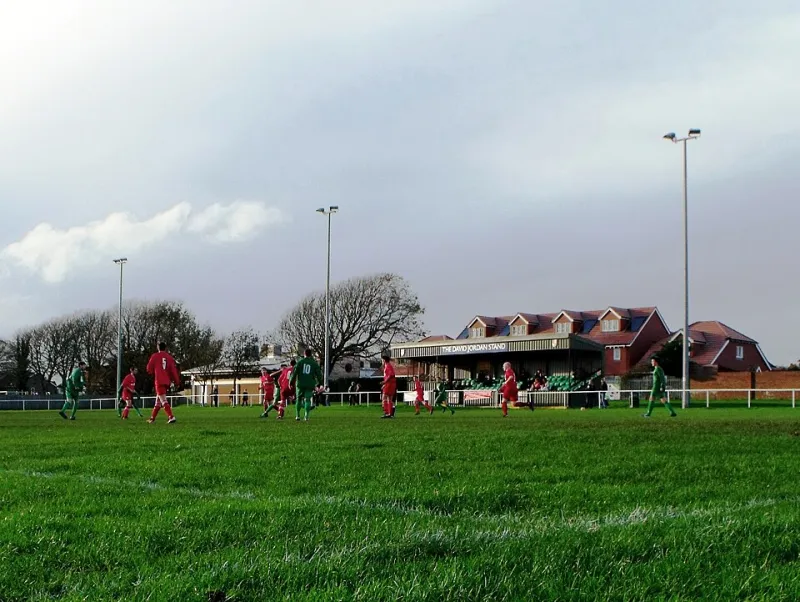
Photo: grassrootsgroundswell, CC BY 2.0, via Wikimedia Commons
At ten past two on a Saturday, the most important piece of equipment at many Ayrshire grounds is not the mower or the corner flag. It is a folding table, a Tupperware tub of coins and a laminated sign that says PROGRAMS 50p — sometimes with the spelling corrected in marker, sometimes not.
You have seen it. Maybe you have walked past it. Maybe you have patted your pockets, found a pound coin, and been handed two programmes and a handful of shrapnel by a committee member who is also the reserve goalkeeper's dad. That exchange takes about four seconds. Behind it sits a week of work.
The artefact that fits in a coat pocket
A modern matchday programme is not a glossy Premier League brochure. In Ayrshire it is usually 12 to 24 pages, A5, held together with a long-arm stapler and hope. The cover might feature a player photo taken on a phone by the secretary. Inside: team lines, a league table that was correct at the time of printing, the chairman's notes, a quiz, a golden goal number, adverts for a local butcher, a taxi firm and a joinery that has sponsored the same page since 2011.
It is also a record. Not the official record — the league and the website do that — but the human one. Who played, who scored, who was missing with a hamstring, who was thanked for twenty years of service. When a club reaches a cup final or loses a founder, the programme cupboard becomes an archive.
Thursday night, kitchen table, floodlights off
The production line is rarely a production line. More often it is one person with a laptop, a template saved in 2016, and a WhatsApp group called something like Programme Stuff. The manager sends the squad after training on Thursday. The secretary sends the league table. The treasurer sends a reminder that the printer cartridge is nearly out.
Then the adverts come in. Some are paid for in cash, some in kind, some in a promise that gets settled in January. A page at the back sells for anything from £20 to £80 depending on the club and the print run. That money is not glamorous. It pays for the paper, the ink, the staples, and sometimes the referee's expenses.
Printing is the tricky bit. A run of 80 programmes costs money. A run of 150 costs more. Print too few and you have a queue of away fans who have travelled forty minutes and want a souvenir. Print too many and you are storing them next to the floodlight bulbs until the next home game, where they will be sold as a back issue for 20p.
Some clubs still use the office photocopier. Some use a local print shop that gives them a deal. One volunteer described printing at home on a domestic printer, one page at a time, while watching a film. The staple is always the last job. It is always done at the kitchen table. It is always later than planned.
Why 50p still works
You can buy a lot of things for 50p. Not many of them involve a child handing over a coin and receiving something to read in the second half when the game is 0-0 and the rain is coming sideways.
The programme is a ritual. It is part of the Saturday. For older supporters it is a habit that predates the internet. For younger ones it is a cheap souvenir, something to get signed, something to fold into a pocket and find again in the washing machine in March. For groundhoppers — and Ayrshire gets its share — it is proof of the visit.
There is also a practical case. Not every fan has a smartphone with a decent signal at a ground surrounded by trees and a hill. Not every away supporter knows the home team's squad. A programme tells them. It gives the announcer a name to read out. It gives the tea bar queue something to talk about.
The club identity question
A programme says a lot about a club. A club with a proper programme is a club that has someone willing to chase the manager for the team lines. It has a sponsor who trusts it. It has a sense of itself.
The digital age has not killed it. It has changed it. Some clubs put the programme online as a PDF, free to download. Some use QR codes on the cover. Some have stopped entirely, and some have brought them back after a season because the table by the turnstile felt empty.
The ones that keep going tend to be the ones where the programme is not just one person's job. It is a small team. A writer. A designer. A seller. A treasurer who signs off the print bill. A teenager who does the quiz. A grandparent who folds 100 sheets while the kettle boils.
The last copy goes in the cupboard
At ten past three the table is packed away. The tin goes back in the boot. The unsold programmes go into a box in the committee room, marked with the date and the opposition. The last copy is not sold. It is kept.
That copy matters. In five years, when someone asks who played left-back in the rain in November, or which sponsor backed the club in the season they went up, the answer might be in a cupboard, stapled on a Thursday, sold for 50p on a Saturday.
If you see the table, buy one. If you are a club without one, find the person who still has the template. The 50p time machine is not complicated. It just needs someone to press print.